
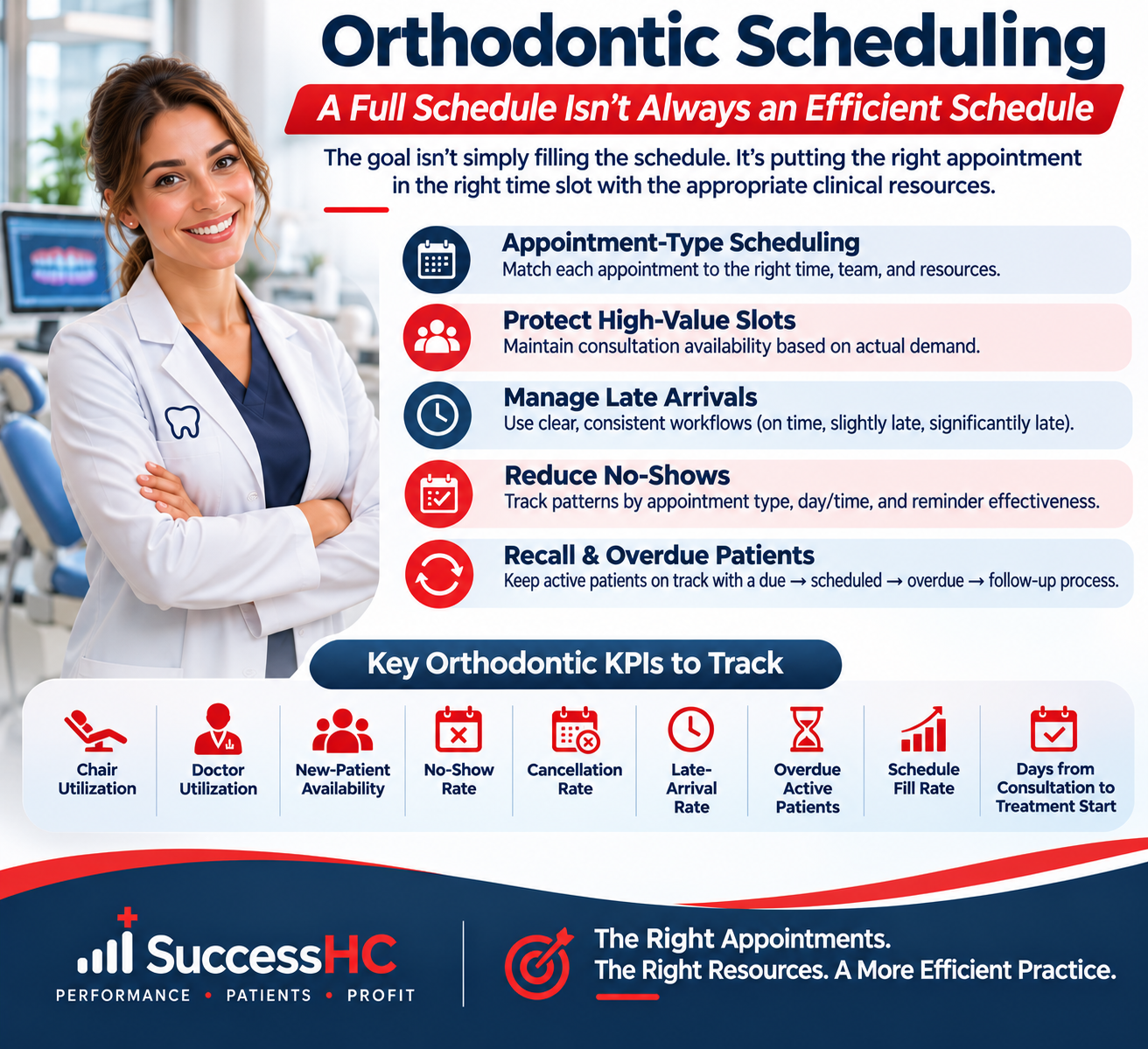
Why smarter scheduling—not simply more appointments—can improve patient access, clinical efficiency, and practice performance.
A busy orthodontic practice can appear highly productive.
Every chair is occupied. The front desk is managing constant calls. Assistants move between patients. The orthodontist works through a packed schedule.
From the outside, everything looks successful.
But here's an important question:
Is the practice operating efficiently, or is everyone simply busy?
Orthodontic scheduling is different from scheduling in many other healthcare specialties.
An orthodontic practice may manage hundreds or thousands of active patients who require recurring appointments throughout treatment, often over 18–30 months, depending on the case.
Some appointments require substantial orthodontist involvement. Others are primarily assistant-supported, with appropriate clinical supervision.
Some visits are predictable. Others are urgent or unexpected.
The goal isn't simply filling the schedule.
It's placing the right appointment in the right time slot, with the appropriate clinical resources available.
1. Not All Appointments Are Created Equal
Consider the variety of appointments an orthodontic practice manages:
- New-patient consultations
- Diagnostic records
- Braces placement
- Clear-aligner starts
- Routine adjustments
- Emergency or broken-bracket visits
- Retainer appointments
- Debonding
- Observation visits
- Treatment-progress evaluations
Each appointment type requires different amounts of chair time, orthodontist involvement, assistant support, and equipment.
Yet some practices rely on scheduling templates that don't adequately reflect those differences.
The result?
A schedule may look completely booked while clinical resources are unevenly distributed.
Assistants become overloaded during certain hours. The orthodontist moves between competing demands. Other chairs remain underutilized.
An effective scheduling template should reflect the actual clinical workflow—not just the available appointment slots.
2. Are Routine Visits Taking Your Most Valuable Appointment Times?
Imagine an orthodontic practice that consistently fills its most desirable afternoon appointment slots with routine adjustments.
Then a parent calls to schedule a new-patient consultation.
The response?
"Our next available consultation is three weeks from now."
The practice may have plenty of scheduled activity, but limited access for prospective patients.
Some families may be willing to wait. Others may explore alternative providers.
This doesn't mean routine patients are less important. Their clinically appropriate follow-up must also be protected.
It means scheduling capacity should reflect different types of demand.
For example, practices can analyze historical consultation requests, preferred appointment times, conversion patterns, and treatment-start capacity to determine whether some consultation slots should be protected.
Unused protected slots can then be released according to a defined policy.
The objective isn't to prioritize revenue over patient care. It's to balance access for new patients with continuity for existing patients.
3. One Late Patient Can Disrupt an Entire Clinic
Late arrivals are a common operational challenge.
A patient arrives 15 minutes late for an appointment scheduled to last 20 minutes.
Should the team proceed?
Should the appointment be shortened?
Should the patient be rescheduled?
Without clear procedures, front-desk employees may make inconsistent decisions, clinical staff may feel pressured, and subsequent appointments may be delayed.
A practical administrative workflow might include:
| Arrival Status | Administrative Response |
|---|---|
| 0–5 minutes late | Follow normal check-in procedures if the appointment remains feasible |
| Significantly late | Ask the clinical team whether the planned care can safely and appropriately proceed |
| Unable to accommodate | Reschedule according to practice policy and clinical guidance |
These are illustrative categories, not universal clinical thresholds.
The clinical team must determine whether treatment can proceed safely.
The administrative team's responsibility is to communicate consistently, coordinate the decision, and manage the schedule.
Clear late-arrival procedures reduce confusion without compromising clinical judgment.
4. No-Shows Are More Than Empty Chairs
Orthodontic treatment depends on repeated patient visits.
A missed appointment may create unused capacity today and require additional scheduling coordination tomorrow.
Repeated missed appointments may also interrupt the intended treatment-monitoring schedule.
Rather than looking only at the overall no-show rate, practices should examine patterns:
- Which appointment types have the highest no-show rates?
- Are missed appointments concentrated on particular days or times?
- Which patients have repeated missed appointments?
- How effective are reminders and confirmations?
- How quickly are missed visits rescheduled?
A 2018 systematic literature review covering 105 studies reported an average appointment no-show rate of approximately 23% across the included settings.
That figure is not an orthodontic-specific benchmark, but it illustrates why missed appointments deserve operational attention.
For orthodontic practices, their own scheduling data will be far more useful than applying a general healthcare average.
The goal isn't simply to send more reminders. It's to understand why appointments are missed and respond to the patterns.
5. The Overdue Patient Problem
One of the most important orthodontic scheduling questions is:
What happens when an active patient leaves without scheduling the next clinically required appointment?
Without a structured recall process, that patient may gradually disappear from the schedule.
A useful tracking workflow is:
Due → Scheduled → Overdue → Contact Attempted → Escalated
The practice can establish a clinically appropriate due date, identify patients who remain unscheduled, and assign follow-up responsibilities.
Overdue reports can help the appropriate team members identify patients who need attention.
Escalation criteria should be established by the clinical team, particularly when delayed follow-up may affect treatment.
An active patient should never become invisible simply because their next appointment wasn't booked.
6. The Numbers That Reveal Scheduling Performance
A full appointment book tells only part of the story.
Orthodontic practices should monitor a balanced group of scheduling indicators.
| KPI | What It Reveals |
|---|---|
| Chair utilization | How effectively available chair capacity is used |
| Orthodontist utilization | Whether clinical time is appropriately allocated |
| New-patient appointment availability | How quickly prospective patients can be seen |
| No-show rate | Percentage of scheduled visits missed without attendance |
| Cancellation rate | Frequency of canceled appointments |
| Late-arrival rate | How often patients arrive beyond the practice's defined threshold |
| Overdue active patients | Patients past their clinically determined follow-up date |
| Schedule fill rate | Percentage of available appointment slots booked |
| Consultation-to-start interval | Days between consultation and treatment initiation |
These metrics should not be interpreted independently.
For example, exceptionally high chair utilization may appear positive but can leave little flexibility for emergencies, late arrivals, or unexpected clinical needs.
Similarly, a high schedule fill rate doesn't necessarily mean appointment types are appropriately distributed.
The most valuable insight often comes from understanding how these metrics interact.
7. The Real Goal: A Schedule That Works for Everyone
Effective orthodontic scheduling requires balancing several competing priorities:
Clinical care: Patients receive appropriate treatment and follow-up without unnecessary pressure.
Patient access: New and existing patients can obtain appointments within clinically and operationally appropriate timeframes.
Team coordination: Orthodontists, assistants, and administrative employees have the resources required for each appointment.
Operational performance: Chairs, staff time, and appointment capacity are used efficiently without eliminating necessary flexibility.
A well-designed schedule doesn't need to operate at maximum capacity every minute.
It needs to operate predictably, safely, and efficiently while accommodating the inevitable changes that occur throughout the day.
Final Thought: Busy Isn't the Same as Productive
Orthodontic practice performance shouldn't be judged solely by the number of patients scheduled or chairs occupied.
A completely full schedule can still contain missed opportunities, unnecessary delays, uneven workloads, and limited access for new patients.
The better question is:
Is every appointment positioned where it makes the most clinical and operational sense?
Because successful scheduling isn't about squeezing more patients into the day.
It's about making the day work better for patients, providers, and the entire practice.
SuccessHC Insight | Orthodontic Practice Performance
Better Scheduling. Better Patient Access. Stronger Practice Performance.
SuccessHC — Performance • Patients • Profit