
Healthcare practices often look for growth in the obvious places.
More marketing.
More patients.
More providers.
More technology.
More locations.
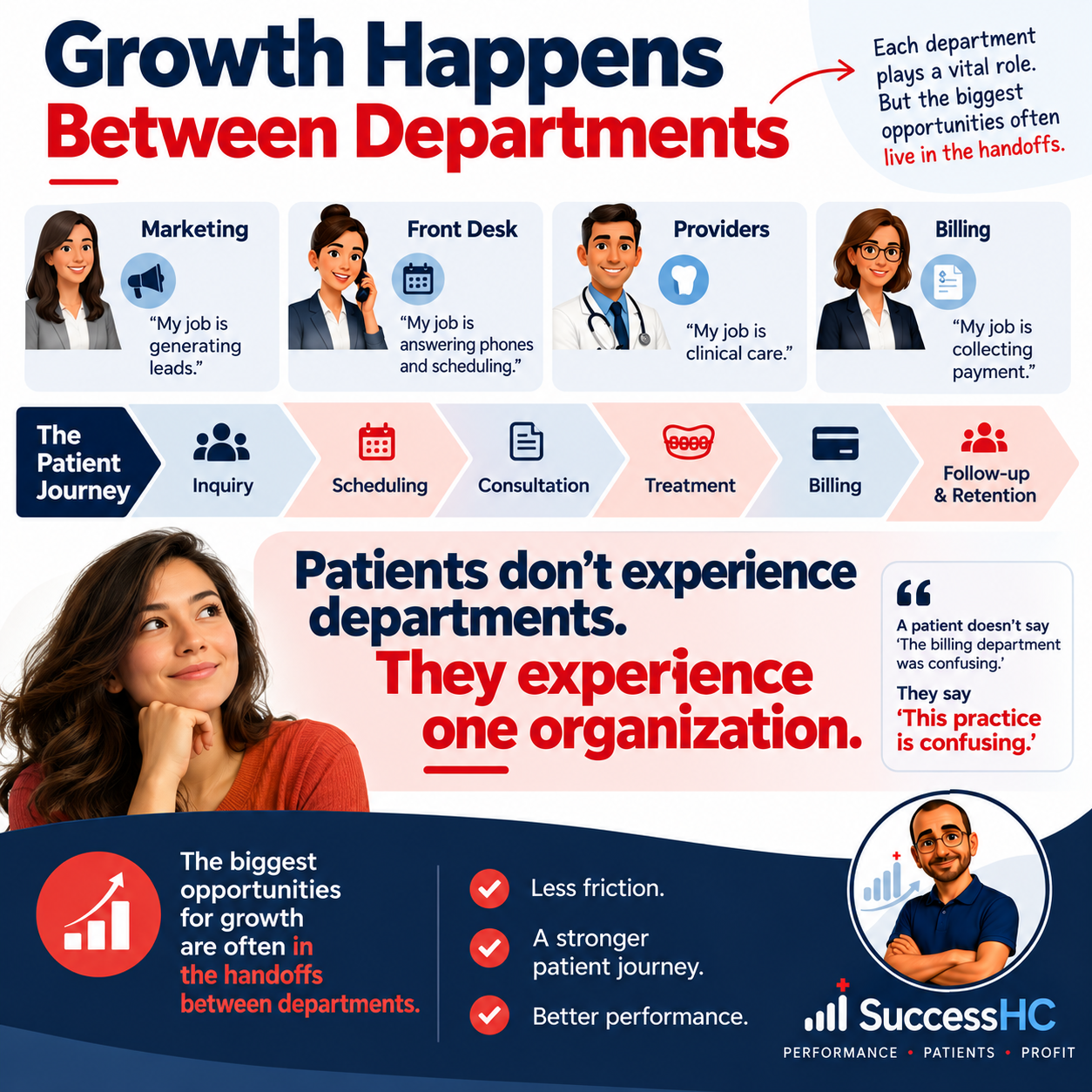
But some of the most important opportunities for growth may already exist inside the practice—and they often live between departments.
The Problem With Organizational Thinking
Most healthcare organizations are structured around departments and responsibilities.
Marketing thinks:
“My job is generating leads.”
The front desk thinks:
“My job is answering phones and scheduling appointments.”
Providers think:
“My job is delivering excellent clinical care.”
Billing thinks:
“My job is collecting payment.”
Each department can perform its individual responsibilities well. The marketing campaign can generate inquiries. The front desk can answer the phone. The provider can deliver excellent care. Billing can submit claims and collect balances.
And yet the patient experience can still feel fragmented.
Why?
Because patients don't experience departments. They experience one organization.
A patient doesn't usually say:
“The billing department was confusing.”
They say:
“This practice is confusing.”
That distinction matters.
Performance Is Often Lost in the Handoffs
Consider a typical patient journey:
Marketing → Inquiry → Scheduling → Registration → Consultation → Treatment → Billing → Follow-up → Retention
Every arrow represents a handoff.
And every handoff represents an opportunity for something to go right—or quietly go wrong.
Marketing may generate a highly interested prospective patient, but what happens when that person calls?
Does someone answer?
If not, how quickly is the call returned?
Does the front desk understand what prompted the inquiry?
Is the patient given a clear next step?
Does the information collected during scheduling reach the clinical team?
After the consultation, does the patient understand the treatment plan, financial responsibility, and what happens next?
If the patient doesn't schedule immediately, who follows up?
After treatment, who maintains the relationship?
None of these questions belongs entirely to one department.
They live between departments.
And that is precisely where operational performance can become difficult to see.
A Great Marketing Campaign Can Still Produce Poor Growth
Imagine an orthodontic practice invests in marketing and generates 100 new inquiries.
Marketing reports strong results because the leads were generated.
But suppose some calls are missed, some inquiries receive delayed responses, some consultations aren't scheduled, and some patients who complete consultations never move forward with treatment.
From marketing's perspective, the campaign worked.
From the front desk's perspective, the phones were busy and the team handled as much as possible.
From the provider's perspective, the consultations that reached the chair were completed.
Everyone may have done their job.
But from the perspective of the patient journey, opportunities disappeared along the way.
The practice doesn't necessarily have a marketing problem.
It may have a handoff problem.
The Same Thing Happens After the Patient Says “Yes”
Operational fragmentation isn't limited to acquiring new patients.
A patient accepts treatment.
Clinical care begins.
Then the patient receives a bill they weren't expecting.
They call the practice.
The front desk isn't sure what was discussed financially.
Billing has different information.
The patient gets transferred.
They explain the situation again.
And perhaps again.
Individually, each department may be following its process.
But the patient doesn't see separate processes.
They see friction.
And friction affects more than convenience. It can influence confidence, satisfaction, referrals, retention, and whether patients continue engaging with the practice.
Stop Looking Only at Departments. Look at the Journey.
Traditional operational reviews often ask questions such as:
How is the front desk performing?
How is marketing performing?
How is billing performing?
Those are useful questions.
But they aren't enough.
A different set of questions can reveal another layer of performance:
What happens between marketing and the front desk?
What happens between scheduling and the consultation?
What happens between the provider's recommendation and treatment acceptance?
What happens between clinical care and billing?
What happens between completing treatment and becoming a long-term advocate for the practice?
This shifts the focus from individual departments to the connections between them.
Measure the Handoffs
Healthcare practices measure many important numbers: revenue, collections, new patients, cancellations, no-shows, production, utilization, and marketing leads.
But some equally valuable questions sit between those metrics.
For example:
→ What percentage of inquiries become scheduled consultations?
→ How quickly are missed calls and online inquiries followed up?
→ What percentage of scheduled consultations actually occur?
→ What percentage of completed consultations move forward with treatment?
→ Where do prospective patients most frequently stop progressing?
→ How often do patients contact the practice because their next step wasn't clear?
These aren't simply marketing, front-desk, clinical, or billing metrics.
They are patient-journey metrics.
And they can help reveal where opportunity is being lost.
Growth Doesn't Always Require More
When growth slows, the instinct is often to add something.
More advertising.
More staff.
More appointment slots.
More software.
More promotions.
Sometimes those investments are necessary.
But before adding more to the top of the system, it is worth examining what is already moving through it.
If 100 opportunities enter a practice and unnecessary friction causes too many to disappear between inquiry, scheduling, consultation, treatment, and follow-up, generating another 100 opportunities may simply feed the same inefficient journey.
The better question may be:
Where are patients losing momentum?
That question changes the conversation.
Instead of immediately asking how to generate more demand, the practice begins asking how effectively existing demand moves through the organization.
The Patient Journey Is Everyone's Responsibility
Departments are necessary.
Departmental thinking is necessary.
But patients don't move through an organizational chart.
They move through an experience.
Every phone call, handoff, appointment, conversation, financial explanation, follow-up, and interaction contributes to their perception of the practice.
The strongest healthcare organizations recognize that performance isn't created only inside departments.
It is also created in the spaces between them.
Because sometimes the next opportunity for growth isn't another marketing campaign, another employee, or another piece of technology.
Sometimes growth is already inside the practice.
The opportunity is simply getting lost in the handoffs.
SuccessHC Insight
Growth Happens Between Departments
Better handoffs. Less friction. A stronger patient journey.
SuccessHC | Performance • Patients • Profit