
Healthcare practices can borrow from retail, but patient growth depends on something deeper: trust built across every interaction in the patient journey.
By Maher · August 20, 2026 · 8 min read
Healthcare practices have adopted many strategies from the retail world—and some of them are valuable.
Digital advertising, online scheduling, customer service principles, reputation management, and convenient payment options can all improve the patient experience.
But there is an important distinction we shouldn't overlook:
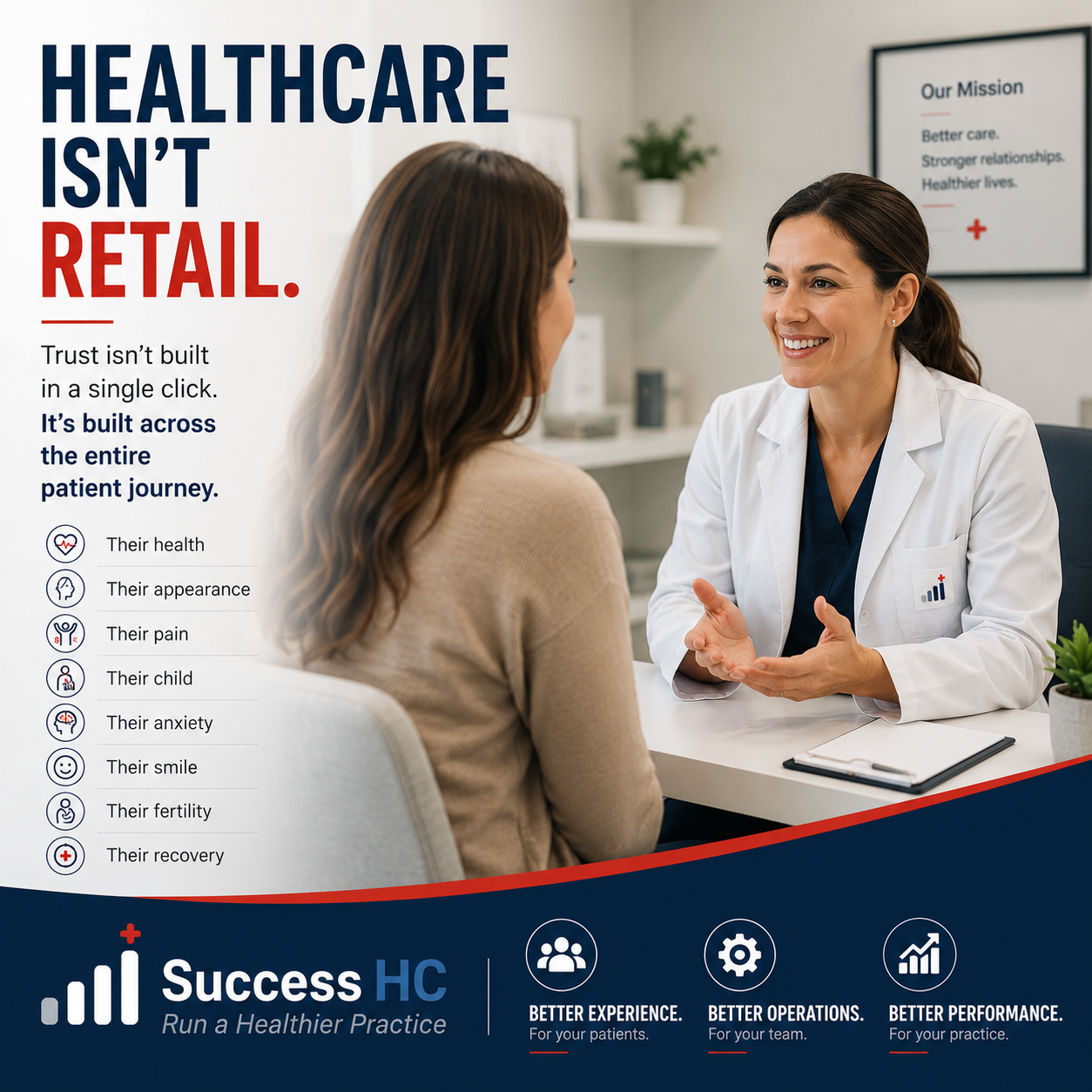
Healthcare isn't retail.
A consumer buying a pair of shoes can compare prices, read reviews, click a button, and complete the transaction within minutes.
A patient choosing a healthcare provider is making a very different decision.
They're being asked to trust someone with their health.
Their appearance.
Their pain.
Their child.
Their anxiety.
Their smile.
Their fertility.
Their recovery.
That changes everything.
In retail, the transaction is often the destination.
In healthcare, the transaction is only one small part of a much larger relationship.
Before a patient ever receives care, they may interact with your practice many times.
They see an advertisement.
Visit your website.
Read your reviews.
Call the office.
Speak with the receptionist.
Schedule an appointment.
Receive a confirmation.
Walk through the front door.
Meet the clinical team.
Wait for the provider.
Discuss treatment.
Ask about cost.
Schedule the next step.
Receive follow-up communication.
Every one of these interactions answers an unspoken question:
“Can I trust this practice?”
Trust isn't created by one great advertisement or one impressive website.
It's accumulated—or lost—across the entire patient journey.
This is where healthcare growth becomes an operational issue.
Marketing may convince someone to contact your practice.
But what happens next?
What happens when the phone rings?
How quickly does someone respond to an online inquiry?
How does the receptionist make the patient feel?
How easy is it to schedule?
Are financial expectations explained clearly?
Does the provider run consistently behind?
Does the patient know what happens next?
Does someone follow up after the visit?
These may appear to be small operational details.
To the patient, they're not small at all.
They're signals.
A missed callback can signal that the practice isn't responsive.
A confusing financial conversation can create uncertainty.
A long unexplained wait can communicate that the patient's time isn't valued.
A warm, knowledgeable receptionist can begin building confidence before the patient ever meets the provider.
Operations are constantly communicating something about your practice—even when you don't realize it.
Healthcare is full of handoffs.
Marketing hands the patient to the front desk.
The front desk hands the patient to the clinical team.
The clinical team hands the patient to the provider.
The provider may hand the patient to a treatment coordinator.
Then come billing, follow-up, scheduling, and ongoing care.
From an organizational perspective, these are different departments and responsibilities.
From the patient's perspective, they're all one practice.
Patients don't care which department caused the problem.
They simply remember how the experience made them feel.
That's why operational excellence isn't just about efficiency.
It's about consistency.
A strong practice creates a patient experience in which each interaction reinforces the confidence established by the one before it.
Healthcare organizations understandably focus heavily on clinical quality.
They should.
But patients often begin forming opinions about the quality of a practice long before they can evaluate the clinical care itself.
They notice whether their call was answered professionally.
Whether instructions were clear.
Whether the office seemed organized.
Whether employees communicated with one another.
Whether they had to repeat the same information several times.
Whether someone remembered why they were there.
Whether the practice followed through on what it promised.
These experiences shape perception.
And perception influences trust.
Trust may sound intangible, but its effects can be very real.
A patient who trusts a practice may be more likely to:
A patient who loses confidence may quietly do the opposite.
They may cancel.
Delay treatment.
Fail to return.
Or simply choose another practice.
That means patient experience isn't separate from practice performance.
Patient experience is one of the drivers of practice performance.
Consider an orthodontic patient evaluating a treatment plan.
A med spa patient considering an aesthetic procedure.
Or a plastic surgery patient considering surgery.
These decisions can involve significant financial, emotional, and personal considerations.
Patients aren't simply comparing products.
They're evaluating people.
Competence.
Safety.
Communication.
Credibility.
Comfort.
And trust.
A practice can generate hundreds of leads, but if the experience after the inquiry creates friction or uncertainty, marketing alone won't solve the problem.
More leads cannot compensate indefinitely for a patient journey that loses trust along the way.
Operational excellence sometimes sounds like something happening behind the scenes—workflows, staffing models, scheduling templates, KPIs, processes, and dashboards.
But patients experience the results of those systems every day.
Good operations can mean:
Shorter waits.
Clearer communication.
Fewer mistakes.
Smoother handoffs.
Better follow-up.
More consistent experiences.
A less stressed team.
And a practice that feels organized and prepared.
Operational excellence isn't about turning healthcare into an assembly line.
It's about removing unnecessary friction so healthcare professionals can focus more effectively on the people they're there to serve.
Practices understandably invest significant resources in attracting new patients.
But acquisition is only the beginning.
Sustainable growth happens when marketing, operations, clinical care, and patient experience work together.
The question shouldn't only be:
“How do we generate more leads?”
It should also be:
“What happens to those patients after they contact us?”
Where do they encounter friction?
Where does communication break down?
Where are appointments lost?
Where does confidence weaken?
Where are patients leaving the journey?
Those questions often reveal opportunities that another advertising campaign won't.
There is plenty healthcare can learn from retail—convenience, responsiveness, personalization, technology, and customer experience among them.
But healthcare should never forget what makes it fundamentally different.
Behind every appointment is a person placing something important in your hands.
Their health.
Their appearance.
Their child.
Their smile.
Their recovery.
Their future.
Trust isn't built in a single click.
It's built across dozens of interactions.
And that's exactly why operational excellence matters.
At SuccessHC, we believe healthier practices are built when people, processes, patient experience, and performance work together.
Because the strongest practices don't simply attract patients.
They earn their trust—and keep earning it throughout the entire patient journey.
SuccessHC | Run a Healthier Practice
Start with a Free Practice Snapshot — a focused review of where your patient journey may be leaking trust, growth, revenue, or time.