
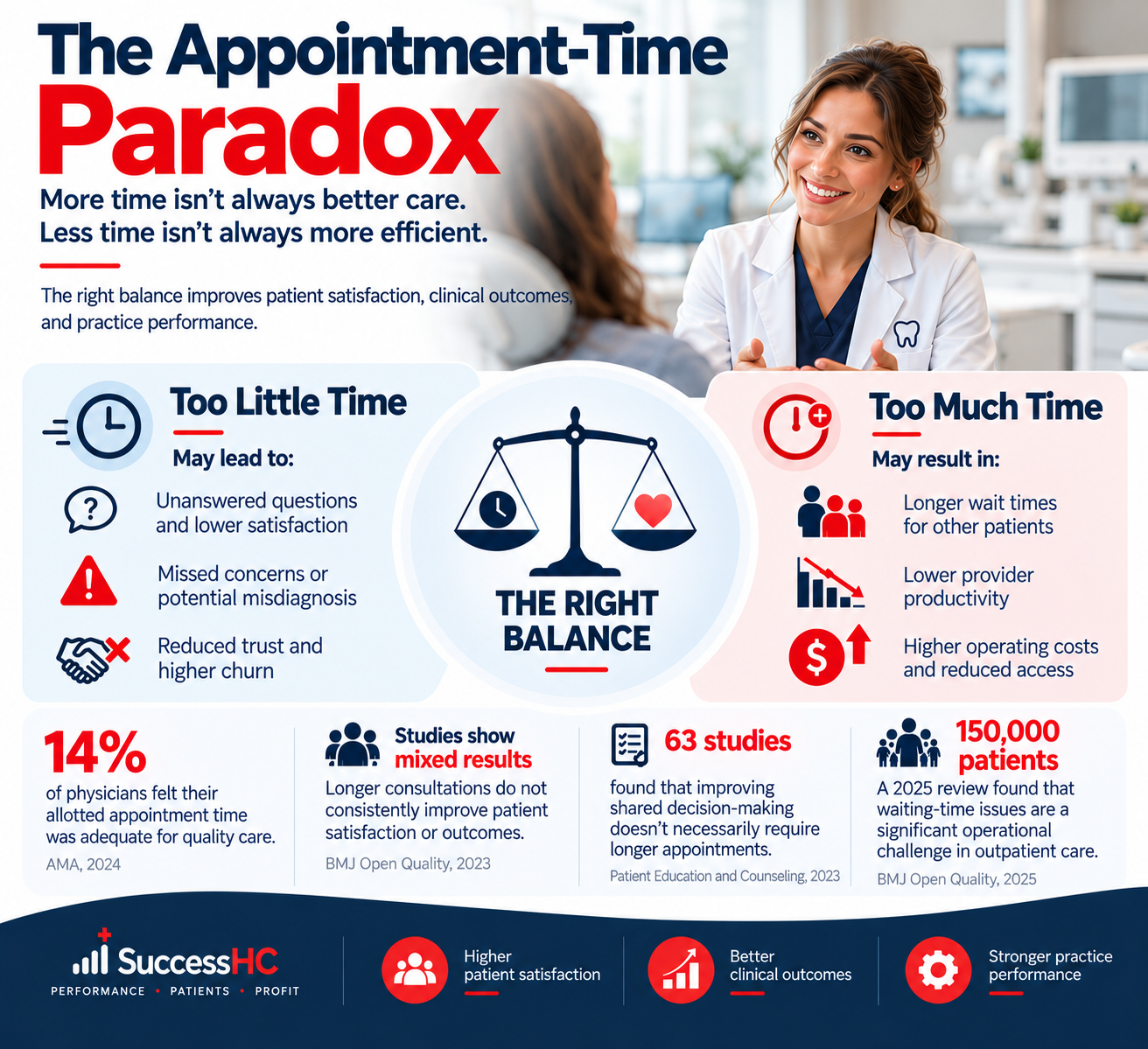
The right amount of time can improve patient experience, protect clinical quality, and strengthen practice performance. But how much time is enough?
Time is one of healthcare's most valuable resources.
Spend too little time with a patient, and important concerns may go unaddressed. Spend more time than necessary, and other patients may experience longer waits, reduced appointment availability, and delayed care.
The challenge is finding the right balance.
Are we measuring the quality of time spent with patients—or simply counting the minutes?
The Pressure to See More Patients
Healthcare providers face competing demands. Patients expect personalized attention, while practices must manage scheduling, staffing, costs, and financial sustainability.
A 2024 American Medical Association report cited survey findings showing that only 14% of physicians felt their allotted appointment time was adequate for the quality of care they wanted to provide.
Physicians reported needing approximately 46 minutes for new patients but were allotted around 35 minutes.
These findings raise an important question:
Are appointment schedules designed around patient needs or practice capacity?
Source: American Medical Association, 2024.
Too Little Time: The Risks of Rushed Care
Short appointments may appear efficient, but rushing patients can have consequences.
Patients may leave with unanswered questions, incomplete understanding of their treatment, or concerns they never had an opportunity to discuss.
A 2023 systematic review published in BMJ Open Quality found that longer consultations sometimes improved patient-centered care and preventive discussions. However, evidence that longer appointments consistently improve satisfaction or clinical outcomes was limited.
The takeaway?
Shorter appointments aren't necessarily more efficient if they compromise communication or create additional follow-up work.
And importantly, patients have different needs. A routine follow-up may require less time than a complex consultation involving multiple conditions, treatment decisions, or language barriers.
A 2025 systematic review of 65 studies found that patients with complex medical and communication needs often required additional consultation time.
One appointment length does not fit every patient.
Too Much Time: The Hidden Operational Cost
Now consider the other side.
What happens when appointments consistently exceed the time clinically necessary?
Other patients may wait longer. Schedules fall behind. Staff must manage delays, and fewer appointments may be available.
A 2025 systematic review involving approximately 150,000 outpatient clients examined interventions to reduce waiting times and found that service-level improvements could help reduce delays, although the evidence had limitations.
This doesn't mean providers should rush patients.
It means appointment duration affects more than the individual encounter.
Patient-centered care includes the patient being seen—and the patients waiting to be seen.
Does More Time Always Mean Better Care?
Not necessarily.
A 2023 systematic review found inconsistent evidence that longer consultations improve patient satisfaction or outcomes.
Another systematic review and meta-analysis involving 63 studies found that improving shared decision-making did not necessarily require longer consultations.
These findings challenge a common assumption:
More minutes do not automatically create more value.
A provider who listens carefully, communicates clearly, and explains the next steps may deliver an excellent experience within an appropriately scheduled appointment.
Meanwhile, a longer visit filled with interruptions, administrative tasks, and unclear communication may still leave patients dissatisfied.
The goal should be better use of appropriate time, not simply longer or shorter visits.
The Real Opportunity: Remove Inefficiency, Not Patient Care
Before shortening appointments, practices should examine how provider time is being used.
How much time is lost because of incomplete patient information, missing records, repeated questions, unnecessary interruptions, or inefficient documentation?
Could some administrative tasks be completed before the appointment?
Could better coordination between the front desk, clinical team, and billing department reduce delays?
Improving these processes can help protect time for meaningful patient interaction.
The objective isn't to make providers work faster. It's to eliminate unnecessary work that consumes valuable clinical time.
Measure More Than the Number of Patients Seen
A provider seeing 20 patients per day isn't automatically more productive than one seeing 16.
Patient complexity, clinical quality, satisfaction, waiting times, and unresolved concerns all matter.
Practices should evaluate performance using a balanced set of indicators:
| Performance Area | What to Measure |
|---|---|
| Patient experience | Satisfaction, communication, understanding |
| Clinical quality | Safety, appropriate follow-up, documentation |
| Scheduling efficiency | Planned versus actual appointment duration |
| Patient access | Waiting times and appointment availability |
| Operational performance | Avoidable interruptions, rework, provider utilization |
These measures provide a more meaningful picture than patient volume alone.
Finding the Right Balance
There is no universal appointment duration suitable for every patient or specialty.
Instead, practices should focus on five priorities:
- Match appointment length to patient needs. Allow additional time for complex cases.
- Improve patient preparation. Complete appropriate administrative steps before the encounter.
- Reduce operational friction. Eliminate unnecessary interruptions and duplicate work.
- Protect clinical judgment. Give providers flexibility when additional time is needed.
- Monitor performance. Track patient satisfaction, waiting times, clinical quality, and scheduling efficiency together.
The goal is not to create the shortest possible appointment.
It's to create the most appropriate appointment for each patient's needs.
Final Thought: Time Is Valuable. How We Use It Matters More.
Healthcare practices often measure productivity by the number of patients seen.
But perhaps a better question is:
How much of the provider's time actually creates value for the patient?
Spending more time with patients isn't automatically inefficient.
And seeing more patients isn't automatically productive.
The real opportunity is finding the balance between attentive care, operational efficiency, and access for other patients.
The best appointment isn't necessarily the shortest or the longest. It's the one that gives the patient the time they need without wasting the time of everyone else.
SuccessHC Insight | Healthcare Practice Performance
The Right Time. The Right Patient. The Right Experience.
SuccessHC — Performance • Patients • Profit
Research References
- American Medical Association. (2024). Council on Medical Service Reports. https://www.ama-assn.org/system/files/i24-cms-reports.pdf
- León-García M, et al. (2023). Does the duration of ambulatory consultations affect the quality of healthcare? A systematic review. BMJ Open Quality. https://doi.org/10.1136/bmjoq-2023-002311
- Lyzwinski L, Evéquoz Y, Rodondi P-Y. (2025). Managing consultation duration in primary care: A systematic review with health equity insights. https://pubmed.ncbi.nlm.nih.gov/41041188/
- Shared decision-making and the duration of medical consultations: A systematic review and meta-analysis. Patient Education and Counseling. https://www.sciencedirect.com/science/article/pii/S0738399122008278
- Manderson K, et al. (2025). Service-level interventions to reduce waiting time in outpatient and community health settings may be sustained: a systematic review. BMJ Open Quality. https://doi.org/10.1136/bmjoq-2024-003235
Research note: Findings are primarily from primary care and general outpatient settings. Their applicability to individual specialties should be assessed in context.