
Clinical excellence matters. But the patient journey involves much more than clinical care.
Imagine a patient receiving treatment at one of the country's leading hospitals.
The physicians are highly experienced. The diagnosis is accurate. The treatment is successful.
Yet the patient describes the experience as frustrating.
Appointments were repeatedly rescheduled.
Laboratory results were delayed.
Insurance approvals took several days.
Discharge involved hours of unnecessary waiting.
The clinical outcome was successful. But was the entire healthcare experience successful?
This is where Value Chain Analysis becomes particularly useful.
What Is Value Chain Analysis?
Introduced by Harvard Business School professor Michael Porter, Value Chain Analysis examines how interconnected organizational activities contribute to the value delivered to customers.
In healthcare, that concept extends beyond traditional business performance.
Value includes clinical outcomes, patient experience, access to care, operational efficiency, and responsible use of resources.
Rather than examining departments independently, Value Chain Analysis looks at how activities work together to deliver care.
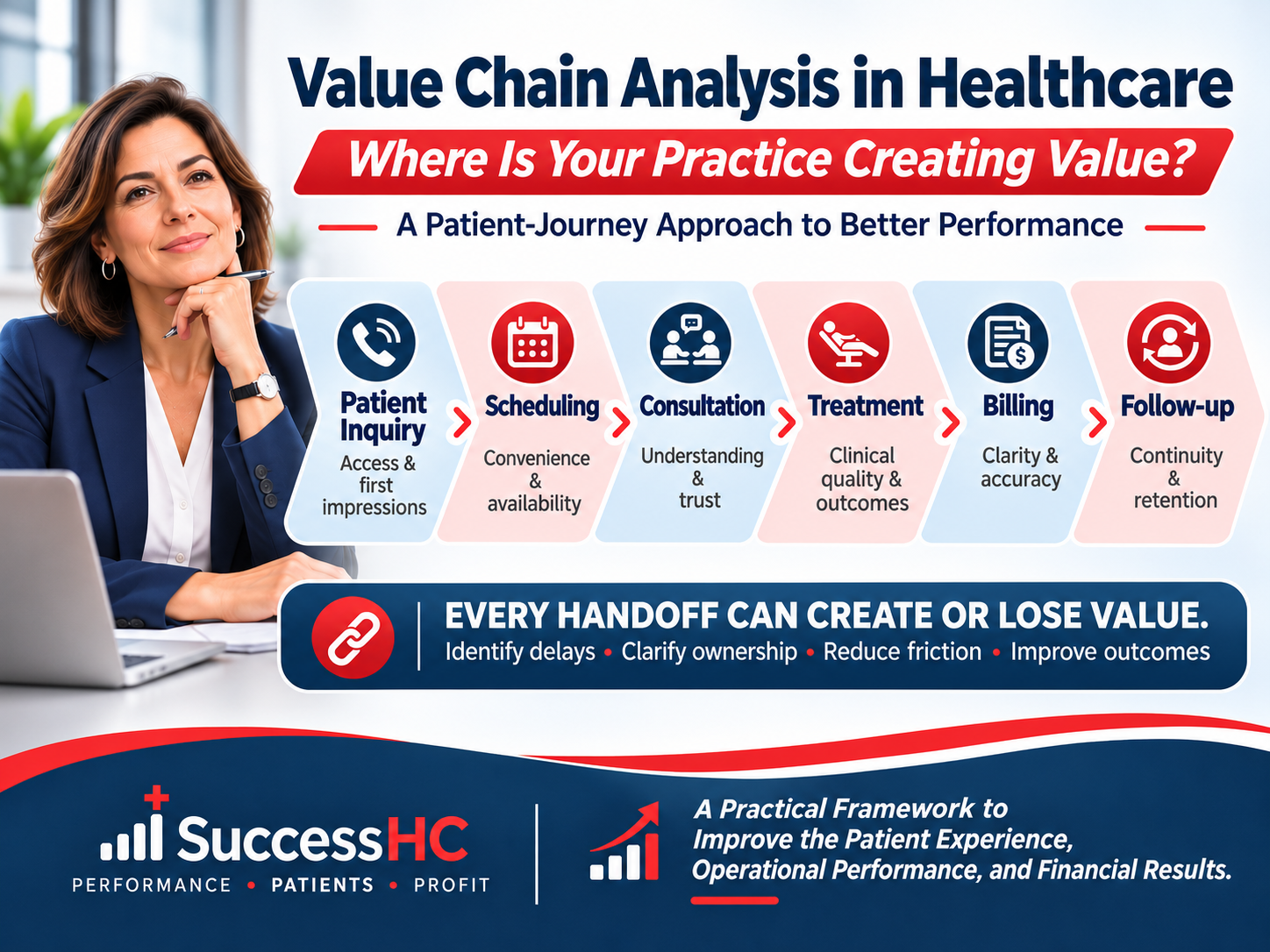
For a healthcare practice, the journey might look like this:
Patient Inquiry → Scheduling → Registration → Consultation → Diagnosis → Treatment → Billing → Follow-Up
Each stage contributes to the patient's experience.
And every transition presents an opportunity to create value—or introduce unnecessary friction.
The Hidden Problem: Departments Can Perform Well While the Practice Underperforms
Consider a healthcare practice where:
- Marketing generates a consistent flow of prospective patients.
- The front desk answers calls and schedules appointments.
- Providers deliver excellent clinical care.
- Billing submits claims accurately.
- Management monitors revenue and expenses.
Individually, every department may appear productive.
But what happens between them?
A prospective patient calls but doesn't receive a timely response.
Insurance information is collected but not verified before the appointment.
The provider recommends treatment, but financial options aren't clearly explained.
A patient completes a consultation but never receives the promised follow-up.
An outstanding insurance claim remains unresolved because responsibility was unclear.
The problem isn't necessarily inside a department. It may exist between departments.
And traditional performance reports don't always reveal these gaps.
Mapping the Healthcare Practice Value Chain
A practical Value Chain Analysis begins by identifying the activities that contribute to delivering care.
| Activity | Value Created | Potential Value Lost |
|---|---|---|
| Patient inquiry | Access and initial trust | Missed calls, delayed responses |
| Scheduling | Convenience and timely access | Long waits, inappropriate appointment allocation |
| Registration | Accurate patient information | Duplicate paperwork, missing records |
| Consultation | Clinical understanding and informed decisions | Rushed explanations, unclear next steps |
| Treatment | Clinical outcomes and patient confidence | Delays, coordination problems |
| Billing | Financial clarity and accurate reimbursement | Confusing statements, unresolved claims |
| Follow-up | Continuity, satisfaction, and retention | Missed recalls, incomplete communication |
The objective isn't to assign blame.
It's to identify where processes create unnecessary work, delays, confusion, or missed opportunities.
Value Is Often Lost in the Handoffs
Consider an orthodontic practice.
A prospective patient completes a consultation and receives a treatment recommendation.
The orthodontist has performed the clinical assessment.
The treatment coordinator presents financial options.
The patient expresses interest but wants time to decide.
Who follows up?
When?
How is the interaction documented?
What happens if the patient doesn't respond?
If no one clearly owns the next step, an otherwise successful consultation may never progress to treatment.
The same principle applies to medical spas and plastic surgery practices, where consultations, treatment planning, financial discussions, scheduling, and follow-up must work together.
A successful interaction does not automatically create a successful patient journey.
Value depends on how effectively one activity connects to the next.
The Financial Impact of Operational Friction
Operational inefficiencies can affect more than patient satisfaction.
They may also influence financial performance.
Consider the potential consequences of:
- Missed inquiries that never become appointments.
- Cancellations that leave unused capacity.
- Incomplete documentation that delays reimbursement.
- Consultations without appropriate follow-up.
- Repeated administrative work.
- Poor scheduling that creates bottlenecks.
Each issue may appear relatively small.
But collectively, these gaps can consume staff time, reduce capacity, delay revenue, and create unnecessary operating costs.
Value Chain Analysis helps identify where improvements may produce the greatest benefit.
However, not every activity should be judged solely by its financial return.
Some activities create essential clinical, safety, regulatory, or patient-centered value even when they do not directly generate revenue.
The goal is to eliminate unnecessary friction—not necessary care.
How to Apply Value Chain Analysis in a Healthcare Practice
A practical assessment can begin with five steps.
1. Map the complete patient journey
Document every major activity from initial inquiry through treatment and follow-up.
Include the administrative and clinical steps patients may never see.
2. Identify who owns each activity
Every critical task should have a clearly assigned owner.
Multiple employees may participate, but accountability for completion must be defined.
3. Examine the handoffs
Determine how information, patients, and responsibilities move between departments.
Look for delays, repeated work, missing information, and unclear next steps.
4. Measure performance
Use relevant indicators such as:
| Performance Area | Example KPI |
|---|---|
| Patient access | Inquiry-to-appointment conversion |
| Scheduling | No-show rate and appointment availability |
| Consultation | Consultation-to-treatment conversion |
| Operations | Process delays and repeated administrative work |
| Revenue cycle | Claim denial rate and days in accounts receivable |
| Patient experience | Complaints, satisfaction, and follow-up completion |
These measures should be evaluated alongside clinical quality and patient safety.
5. Prioritize improvements
Not every problem requires an immediate investment in additional employees, software, or marketing.
Sometimes the greatest improvement comes from clarifying responsibilities, simplifying a handoff, or eliminating duplicate work.
Start with changes that have meaningful potential to improve patient experience, clinical reliability, or operational performance.
Then measure whether those changes actually work.
Value Chain Analysis Is More Than Cost Reduction
One of the biggest misconceptions about operational improvement is that it means doing more with fewer resources.
That is not always the objective.
In healthcare, value can be created by:
Improving access: Helping patients obtain appropriate appointments sooner.
Strengthening communication: Making treatment plans, financial expectations, and next steps easier to understand.
Reducing delays: Eliminating unnecessary waiting and administrative bottlenecks.
Supporting clinical teams: Protecting provider time for activities requiring clinical expertise.
Improving continuity: Ensuring patients receive appropriate follow-up throughout their care.
Strengthening financial performance: Reducing avoidable rework and improving the reliability of administrative processes.
A more efficient practice is not necessarily one that sees the most patients.
It is one that consistently delivers appropriate care while using its resources effectively.
Final Thought: Look Beyond Departments
Healthcare practices are often organized around functions.
Marketing.
Front desk.
Clinical care.
Treatment coordination.
Billing.
Follow-up.
But patients don't experience an organizational chart.
They experience one continuous journey.
A practice may have excellent employees, advanced technology, and outstanding clinical expertise.
Yet if the activities connecting those resources are poorly coordinated, the patient experience—and overall practice performance—can suffer.
Value Chain Analysis encourages healthcare leaders to ask a different question:
Where, along the entire patient journey, are we creating value—and where are we unintentionally losing it?
Because sometimes the next opportunity for improvement isn't inside a department.
It's in the connections between them.
SuccessHC Insight | Healthcare Practice Performance
Better Connections. Less Friction. Greater Value.
SuccessHC — Performance • Patients • Profit
Reference
Porter, M. E. (1985). Competitive Advantage: Creating and Sustaining Superior Performance. Free Press.
Porter, M. E. (2010). What Is Value in Health Care? New England Journal of Medicine, 363, 2477–2481. https://doi.org/10.1056/NEJMp1011024
Note: Traditional Value Chain Analysis and Porter's healthcare value framework are related but distinct concepts. This article applies value-chain thinking to operational activities across the patient journey.