
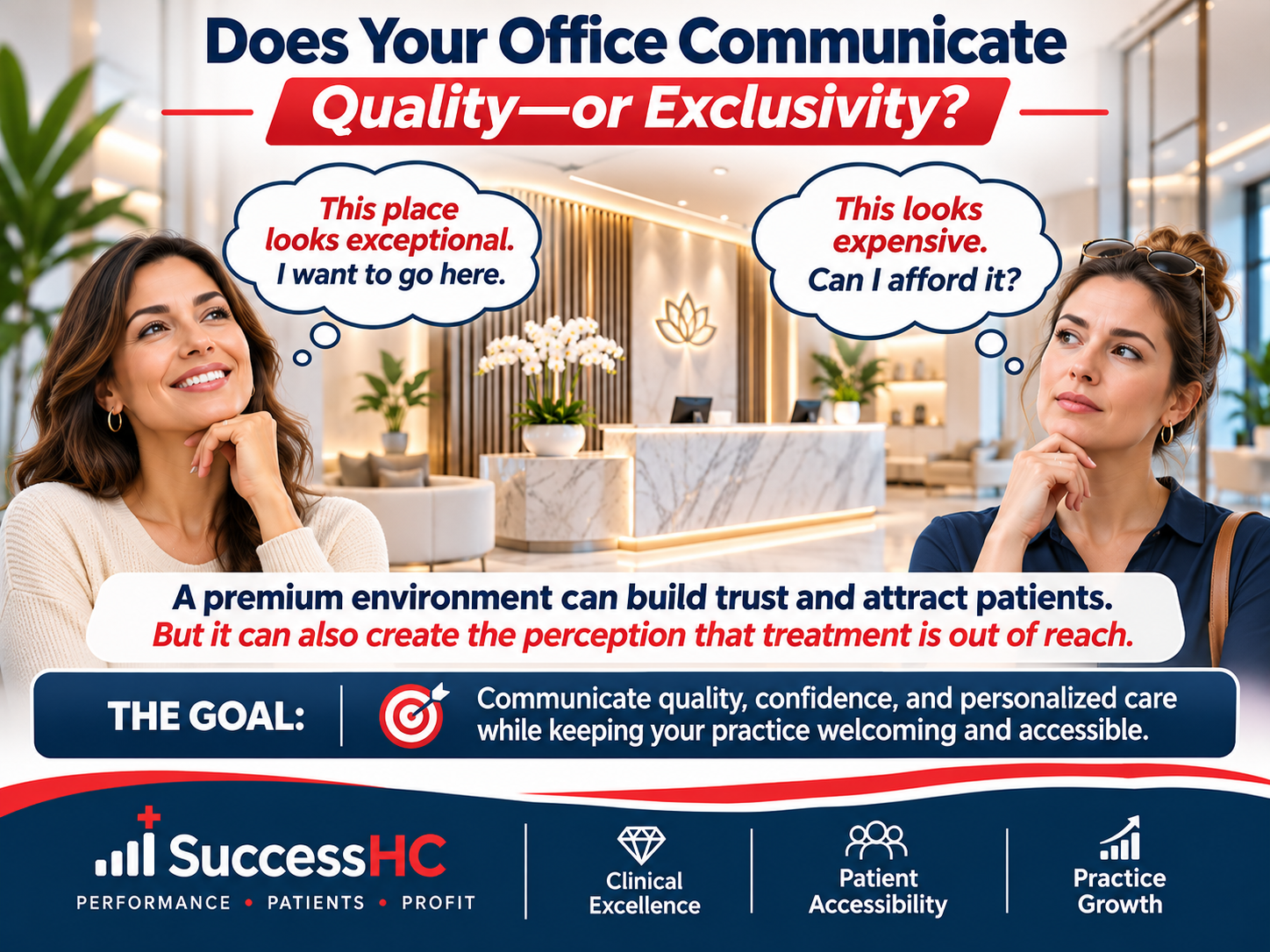
A premium environment can build confidence. But can it also create the perception that treatment is unaffordable?
Imagine two prospective patients walking past a beautifully designed medical spa or orthodontic practice.
The office is located in an upscale neighborhood. The entrance is elegant. The furniture is expensive. The lighting is carefully designed, and the reception area resembles a luxury hotel.
The first patient thinks:
"This place looks exceptional. I want to be treated here."
The second thinks:
"This looks expensive. I probably can't afford it."
Neither patient has asked about pricing.
Neither has spoken with the staff.
Yet both have already formed an opinion.
The practice has communicated something before the first conversation even begins.
And that raises an important operational and marketing question:
Could the appearance of your practice be attracting one group of patients while unintentionally discouraging another?
The Psychology of Perceived Affordability
Patients evaluate healthcare practices using more than clinical credentials and online reviews.
They also interpret environmental signals.
Location, interior design, furnishings, photography, branding, and even the language used on a website can influence expectations about quality, service, and price.
A premium environment may communicate professionalism, attention to detail, comfort, and exclusivity.
Those impressions can be valuable, particularly in elective healthcare.
However, some prospective patients may interpret the same signals as evidence that treatment is financially out of reach.
This creates a potential disconnect between actual affordability and perceived affordability.
A practice may offer competitive prices, payment plans, insurance assistance, or several treatment options.
But if prospective patients assume the practice is too expensive, they may never contact it to discover those options.
The opportunity can disappear before the practice even knows it existed.
Luxury Is Not the Problem. Unclear Positioning Is.
An elegant office is not inherently a disadvantage.
For many patients, a premium environment reinforces confidence and supports the experience they expect.
The problem arises when a practice communicates luxury but provides little information about accessibility.
Consider two messages:
Message A: "Experience world-class aesthetic excellence in an exclusive luxury environment."
Message B: "Personalized aesthetic care, transparent treatment options, and a comfortable, professional experience."
Both can describe a high-quality practice.
But they may create very different expectations about who the practice serves.
The objective isn't to make a beautiful office look less beautiful.
It's to make quality feel welcoming rather than financially intimidating.
Different Specialties, Different Perceptions
The challenge can look different across healthcare specialties.
Orthodontics: Families Need Confidence and Clarity
An orthodontic practice may have a modern office, advanced equipment, and an upscale appearance.
Parents may appreciate those features.
But they may also worry about the total cost of braces or clear-aligner treatment, especially when planning for more than one child.
An orthodontic practice can communicate both clinical quality and financial accessibility by explaining insurance participation, available payment arrangements, and treatment options where applicable.
The message should be:
Excellent orthodontic care and financial transparency can coexist.
Medical Spas: Luxury Shouldn't Create Unnecessary Intimidation
Medical spas often rely on attractive interiors, sophisticated branding, and an elevated customer experience.
Those elements can strengthen positioning.
But a prospective patient interested in a relatively modest treatment may assume the practice caters only to high-spending clients.
A clear treatment menu, transparent starting prices where appropriate, and welcoming educational content can help correct that perception.
Premium service does not have to mean that every visit requires a premium-sized purchase.
Plastic Surgery: Trust Matters More Than Décor
Plastic surgery practices frequently emphasize sophistication, privacy, and individualized care.
Those characteristics can be important to prospective patients.
However, a luxurious office should not overshadow information about surgeon qualifications, safety, treatment suitability, recovery, and realistic financial expectations.
Patients considering significant elective procedures need confidence in the clinical decision—not simply the surroundings.
An effective practice communicates quality through expertise and transparency, with the physical environment reinforcing that message.
Five Ways to Balance Premium Positioning With Accessibility
1. Make Pricing Expectations Less Mysterious
Not every procedure can have a fixed advertised price.
Costs may vary according to treatment complexity, clinical requirements, and individual circumstances.
But practices can still explain how pricing works, what affects cost, whether consultations involve a fee, and which payment options may be available.
Transparency helps prospective patients make informed decisions before committing their time.
2. Communicate Value Beyond Appearance
A beautifully designed office is a feature.
Clinical expertise, clear communication, safety, coordinated care, and reliable follow-up are sources of patient value.
Marketing should emphasize those benefits rather than relying primarily on luxury imagery.
Patients should understand what makes the care valuable—not simply what makes the office expensive-looking.
3. Use Inclusive, Welcoming Language
Words such as "exclusive," "elite," and "luxury" can be appropriate for a deliberately premium brand.
But overusing them may reinforce the impression that the practice serves only a narrow audience.
A welcoming message can preserve sophistication while emphasizing personalized care, transparency, and respect.
4. Show More Than the Beautiful Office
Website and social media photography should not consist entirely of designer furniture, elaborate reception areas, and high-end finishes.
Show the clinical team, treatment explanations, patient education, and the actual care environment.
Authentic, professional imagery can help prospective patients understand what the experience involves.
5. Measure Whether Perception Is Affecting Conversion
This is where the issue becomes an operational performance question.
Practices can examine:
- How often prospective patients ask about pricing before scheduling.
- How many inquiries become consultations.
- How often cost concerns arise during consultation.
- Consultation-to-treatment conversion rates.
- Reasons prospective patients decide not to proceed.
- Whether different marketing messages attract different types of inquiries.
A practice could also test two approaches: one emphasizing its premium environment and another emphasizing quality, personalized care, and financial transparency.
The results may reveal whether the practice's current positioning is unintentionally discouraging suitable prospective patients.
Importantly, declining treatment is not always evidence of a pricing or branding problem. Clinical suitability, patient preferences, timing, and financial circumstances also matter.
Don't Confuse Affordability With Discounting
Making a practice feel financially approachable does not require lowering prices.
Nor does it require promoting discounts, compromising clinical standards, or abandoning a premium identity.
Affordability is partly about cost. Accessibility is also about clarity, expectations, and choice.
A practice can maintain premium facilities, excellent clinical standards, and a strong brand while clearly communicating the services and financial arrangements it genuinely offers.
The objective is to help appropriate prospective patients make informed decisions rather than self-exclude based on assumptions.
Final Thought: What Is Your Office Communicating?
Healthcare practices invest considerable resources in creating beautiful spaces.
And those investments can contribute to a positive patient experience.
But the appearance of a practice also communicates a message about its identity.
The question is whether that message accurately reflects the people it wants to serve.
Does your office say, "You will receive excellent care here"?
Or does it unintentionally say, "This place probably isn't for you"?
The distinction may influence how many prospective patients contact the practice, how they perceive its value, and whether they feel comfortable exploring treatment options.
A successful practice doesn't necessarily need to look less luxurious.
It needs to make sure that luxury isn't mistaken for inaccessibility.
SuccessHC Insight | Healthcare Practice Performance
Premium Experience. Clear Expectations. Greater Accessibility.
SuccessHC — Performance • Patients • Profit