
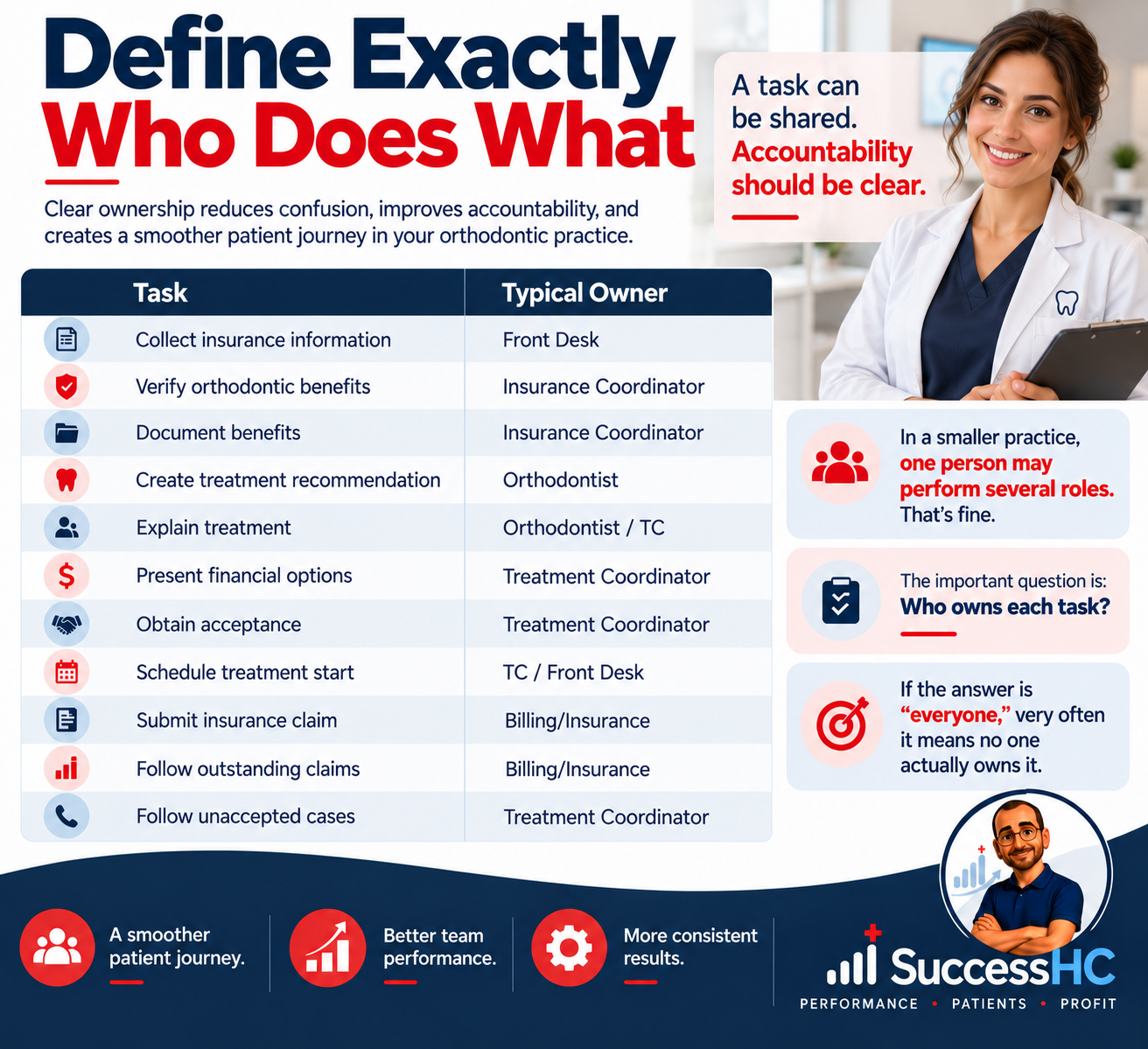
Clear responsibilities. Stronger accountability. A smoother patient journey.
An orthodontic practice can have an excellent clinical team, modern technology, strong patient demand, and a dedicated administrative staff.
Yet operational challenges can still arise from something surprisingly simple:
Nobody knows exactly who owns the next step.
One of the first things worth examining in an orthodontic practice (as in any other practice) is not necessarily how many employees it has or how busy everyone appears.
It's whether every important responsibility has a clearly designated owner.
When Everyone Is Responsible, Who Is Accountable?
Consider a typical orthodontic patient journey.
A prospective patient schedules a consultation. Insurance information is collected. Benefits are verified. The orthodontist evaluates the patient and recommends treatment. Financial options are presented. The patient makes a decision.
If treatment is accepted, appointments are scheduled, claims are submitted, and outstanding balances are monitored.
If treatment is not accepted immediately, follow-up may be necessary.
Each step sounds straightforward.
But what happens when responsibilities are assumed rather than explicitly assigned?
The front desk believes the insurance coordinator will obtain the missing information.
The insurance coordinator believes the treatment coordinator already received the benefit details.
The treatment coordinator assumes someone else will contact the patient who hasn't made a decision.
Billing believes an outstanding claim is being followed up by another team member.
Everyone is busy.
Everyone is working.
Yet important tasks may remain incomplete.
The problem isn't necessarily effort. It may be ownership.
Mapping Responsibilities Across the Patient Journey
A practical starting point is to identify every critical task and assign a primary owner.
The following example illustrates how responsibilities might be distributed in an orthodontic practice.
| Task | Typical Primary Owner |
|---|---|
| Collect insurance information | Front Desk |
| Verify orthodontic benefits | Insurance Coordinator |
| Document insurance benefits | Insurance Coordinator |
| Create treatment recommendation | Orthodontist |
| Explain treatment | Orthodontist / Treatment Coordinator |
| Present financial options | Treatment Coordinator |
| Obtain and document treatment acceptance | Treatment Coordinator |
| Schedule treatment start | Treatment Coordinator / Front Desk |
| Submit insurance claim | Billing / Insurance |
| Follow outstanding claims | Billing / Insurance |
| Follow up on unaccepted cases | Treatment Coordinator |
These assignments are examples, not universal staffing requirements.
Every practice operates differently.
In smaller practices, one employee may handle several responsibilities. In larger organizations, duties may be divided among specialized teams.
The goal isn't to create more positions. It's to eliminate uncertainty about who is responsible for completing each task.
Clinical decisions must remain with appropriately qualified professionals, while administrative and coordination responsibilities should follow the practice's established policies.
The Difference Between Doing a Task and Owning It
This distinction is important.
Completing a task means performing an activity.
Owning a task means being accountable for ensuring that the activity reaches its intended outcome.
For example, collecting insurance information is not the same as confirming that benefits have been verified and communicated to the appropriate team member.
Presenting a treatment plan is not the same as ensuring that the patient understands the next step.
Contacting an undecided patient once is not necessarily the same as managing a defined follow-up process.
An effective owner knows:
What must be completed.
When it must be completed.
What information is required.
Who receives the completed work.
What happens if the task cannot be completed.
Ownership creates continuity.
The Hidden Cost of Unassigned Responsibilities
When responsibilities are unclear, the consequences may not be immediately visible on a financial report.
Instead, they appear as everyday operational problems.
A consultation is delayed because insurance verification is incomplete.
A patient calls repeatedly because no one communicated the next step.
A treatment start is postponed because scheduling responsibilities were unclear.
An insurance claim remains unresolved because follow-up was assumed to be someone else's responsibility.
An interested patient never receives a timely follow-up after the consultation.
Individually, these incidents may seem minor.
Collectively, they can affect staff productivity, scheduling efficiency, patient confidence, treatment progression, and financial performance.
Small gaps in accountability can become significant gaps in performance.
Five Questions Every Orthodontic Practice Should Ask
A useful operational review can begin with five simple questions:
1. Does every critical task have a designated owner?
Not just a department, but a specific role or individual accountable for completion.
2. Does the owner know what successful completion looks like?
Clear expectations reduce inconsistent execution.
3. Is there a defined handoff to the next person?
The next team member should receive the information needed to continue without unnecessary delays.
4. What happens when the assigned person is unavailable?
Backup responsibilities should be established before an absence creates a bottleneck.
5. How does the practice know the task was completed?
A documented status, task-management system, or consistent follow-up process can make incomplete work visible.
These questions help practices move beyond informal assumptions toward more reliable operations.
Clarity Does Not Mean Micromanagement
Defining responsibilities is sometimes misunderstood as adding bureaucracy.
It doesn't have to be.
A well-designed responsibility structure can actually give employees greater independence.
When team members understand their roles, decision-making authority, and handoff expectations, they spend less time asking who should handle something.
Managers spend less time resolving preventable confusion.
Patients experience fewer unnecessary delays.
The objective isn't to control every action.
It's to make the work easier to complete correctly and consistently.
The Real Opportunity Is Operational Clarity
Healthcare organizations often look to technology, hiring, and marketing when they want to improve performance.
Those investments can be valuable.
But sometimes meaningful improvement begins with a much simpler exercise:
Write down the critical tasks.
Assign an owner.
Define what completion means.
Establish the handoff.
Make accountability visible.
Because the strength of an orthodontic practice isn't determined only by the quality of its individual team members.
It also depends on how effectively their responsibilities connect.
And that brings us back to one important question:
Who owns each task?
If the answer is "everyone," there may be no clear owner at all.
SuccessHC Insight | Orthodontic Practice Performance
Clear Ownership. Better Coordination. Stronger Performance.
SuccessHC — Performance • Patients • Profit